Residential concrete in Hoover
Hoover is really several towns' worth of housing inside one city limit. Houses perched on the crest of Shades Mountain, established Riverchase streets from the 1970s through the 1990s, gated golf communities on the Shelby County side and brand-new construction in the southwest all sit under the same name. The right concrete decision depends heavily on which of those you live in, so this page walks through Hoover neighborhood by neighborhood and explains what a homeowner in each should look for.
One city, two counties and four decades of building
Hoover was incorporated in 1967 and has grown mostly by annexation, which is why it reaches across both Jefferson and Shelby counties. Riverchase came in around 1980, and large planned communities such as Ross Bridge followed in the 2000s. The practical result for concrete is that a driveway on one street may be approaching fifty years old while the driveway a mile away was poured last spring.
Age changes the question you should be asking. On an older drive, the issue is usually whether the slab has reached the end of its useful life or simply needs its joints, edges and drainage tended. On a young one, the issue is whether early cracking points to a problem with the ground underneath that will keep getting worse.
Bluff Park and the Shades Mountain crest
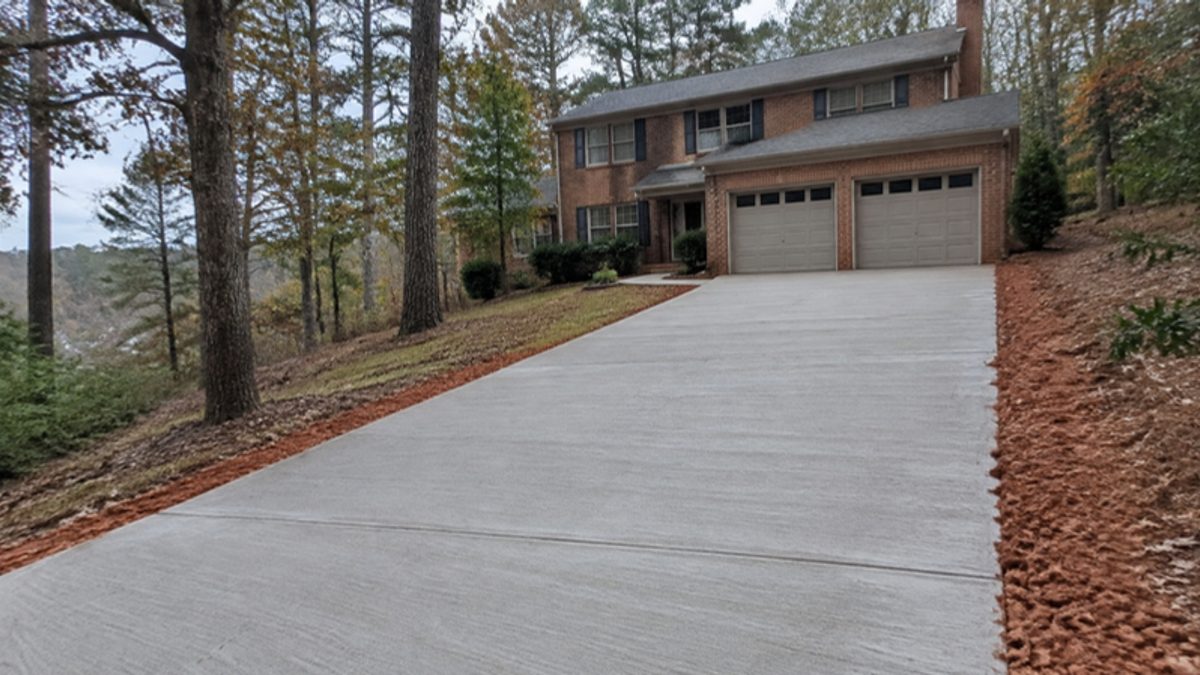
Bluff Park sits along the top of Shades Mountain at the northwest edge of the city, and many of its lots fall away sharply from the street. Driveways there are often steep, sometimes curving, and they tend to end at a garage set into the hillside with a daylight basement below. The soil on the ridge is commonly thin, rocky and mixed with sandstone, which drains better than valley clay but can be uneven to dig into.
On a steep drive, ask how the contractor plans to keep the surface from becoming slick, since a heavier broom texture helps tires grip on a wet morning. Ask too about the transition at the garage slab and at the street, where steep drives often crack or scrape car bumpers. Runoff picks up speed on a grade, so the plan should say where the water leaving the bottom of the driveway will go.
Riverchase and the established middle of the city
Much of Riverchase was built between the 1970s and the 1990s, under a canopy that has had decades to mature. Those big trees are part of the appeal, but their roots lift sidewalk panels and driveway edges, and their shade keeps some patios damp enough to grow moss and stay slippery. Original concrete from this era is common, and much of it has been patched more than once.
Local news has covered a sinkhole that opened in a shopping center parking lot in the Riverchase area, a reminder that parts of the metro sit over limestone. That does not mean a cracked patio is a sinkhole. A sudden, bowl-shaped dip, or a hole that keeps reopening after it is filled, is the kind of sign that deserves a closer look before anyone pours fresh concrete over it.
Ross Bridge, Trace Crossings and newer construction
Ross Bridge began development in 2004, and the southwestern side of the city around Trace Crossings, Lake Wilborn and newer communities nearby has seen a lot of recent building. These houses typically sit on pads that were cut and filled during grading. Fill that was not compacted well continues to settle for years, and it often shows first as a driveway panel dropping beside the garage or a patio tipping toward the back door.
If your home is newer, photograph any cracks now and again in six months. A crack that stays hairline and level is common and usually cosmetic. One that widens, steps up on one side or keeps growing in length suggests the ground is still moving, and that is worth raising with a contractor before adding a patio extension or a wider parking pad on top of the same fill.
Inverness, the gated golf communities and the Shelby County side
On its eastern side, Hoover reaches into Shelby County through Inverness, a large gated golf community and other neighborhoods near the Highway 280 corridor. Parts of that gated community have steep terrain, larger homes and long driveways with turnarounds. Neighborhoods built around small private lakes, here and elsewhere in the city, add retaining walls and yards that slope down toward water.
Large, decorative projects are common here, from stamped motor courts to wide patios around outdoor kitchens. For work this size, it helps to ask how the contractor will break the pour into sections, where the joints will land in a patterned surface, and how the sealer will be maintained so the color holds up through Alabama summers.
Questions worth asking on a Hoover estimate
- Which county and which office reviews this address, and does the HOA need to see the plan first?
- How will runoff from the new surface be handled on a sloped lot?
- What base material goes down, and how will it be compacted over any fill?
- Where will control joints be placed, and when will they be cut?
- How will the new slab meet the garage floor, steps and street apron?
- What happens to tree roots found during excavation?
Approvals, HOAs and neighborhood rules
Because Hoover spans two counties and contains many planned communities, the approval path varies by address. Some neighborhoods have architectural committees that review changes visible from the street, and work at the curb may involve the city. Rather than guessing, check with the City of Hoover and your HOA before scheduling, and keep any approval letters with your project paperwork so the contractor can follow them.
What homeowners here ask most
My Bluff Park driveway is very steep. Is concrete still a good choice?
Usually, yes. Concrete holds up well on steep grades when the base is solid and the surface has enough texture for traction. The details that matter are the broom finish, the joint layout, drainage at the bottom of the slope and how the drive meets the garage and street. Ask the contractor to explain how each of those will be handled on your particular grade before you agree to a plan.
Our Riverchase driveway is original. Should we replace it or repair it?
That depends on how it has aged. If the panels are mostly level, drain properly and have only stable cracks, cleaning, sealing joints and correcting downspouts may buy many more years. If several panels are broken, sunken or lifted by roots, replacement is often the better value over time. A contractor can walk the driveway with you and point out which sections are sound and which are not.
Our house in Ross Bridge is only a few years old and the patio is cracking. Why?
Early cracking on newer homes often traces back to settling fill under the slab, joints spaced too far apart, or downspouts emptying near the edge. Hairline cracks that stay level are common. Cracks that widen or develop a height difference suggest the ground is still moving. Document what you see over a few months and share the photos with a contractor before deciding on a repair or extension.
Is Hoover in Jefferson County or Shelby County?
Both. Hoover crosses the county line, with much of its eastern side, including the area around Inverness, in Shelby County. For concrete work, that can affect which offices are involved and how any review is handled. Check with the city and your HOA early, and give the contractor your exact address so they can plan around the right requirements.
Can a stamped motor court or large patio be poured in one day?
Large decorative areas are often placed in sections rather than all at once, because a crew can only stamp and finish so much concrete before it sets. Sections also let joints fall at sensible places within the pattern. Ask the contractor how the work will be divided, how the seams will look and how long each stage will take, so you know what to expect on the schedule.
Should I worry about sinkholes under my Hoover patio?
Most cracked or settled patios are caused by ordinary issues like poorly compacted fill, clay movement or water running under the edge. Sinkholes are less common, but parts of the area do sit over limestone. Warning signs include a sudden round depression, soil disappearing into a hole, or a low spot that keeps reopening after it is filled. If you see those, have the ground checked before new concrete is poured.
Talk through your project
Start with the address, what you want poured or replaced, rough dimensions, and a few photos of the area and any existing concrete.
The work, by type
Concrete Driveways
New drives, widening and tear-out on sloped Birmingham lots.
Concrete Patios
Backyard patios pitched to carry storm water off, not in.
Stamped & Decorative Concrete
Pattern, color and aggregate finishes, and the sealer they need.
Walkways & Steps
Front walks, stoops and even steps up hillside yards.
Garage, Shed & RV Slabs
Pads for sheds, shops, garages, boats and campers.
Concrete Repair & Replacement
Reading a failed slab before choosing patch, lift or tear-out.
More of Jefferson County
Jefferson County overview
Birmingham, Homewood, Hoover, Trussville and the older terraced lots in between.
Vestavia Hills
Steep Shades Mountain lots, terraced patios and mid-century drives.
Mountain Brook
Front walks and steps on wooded, winding lots near the three villages.
Homewood
Narrow drives, porch steps and alley access on older, closely spaced lots.
Trussville
Newer subdivision drives and patios along the upper Cahaba.