Residential concrete in Mountain Brook
Mountain Brook was laid out as a planned suburb, with large lots strung along curving roads between Red Mountain and Shades Mountain and very little of the original woodland cleared. That setting is what people love about it, and it also shapes every concrete project. Old trees, established gardens, stone and brick details and long winding driveways all have to be worked around. This page looks at how to plan concrete that fits an older, carefully landscaped property and how to compare quotes for that kind of work.
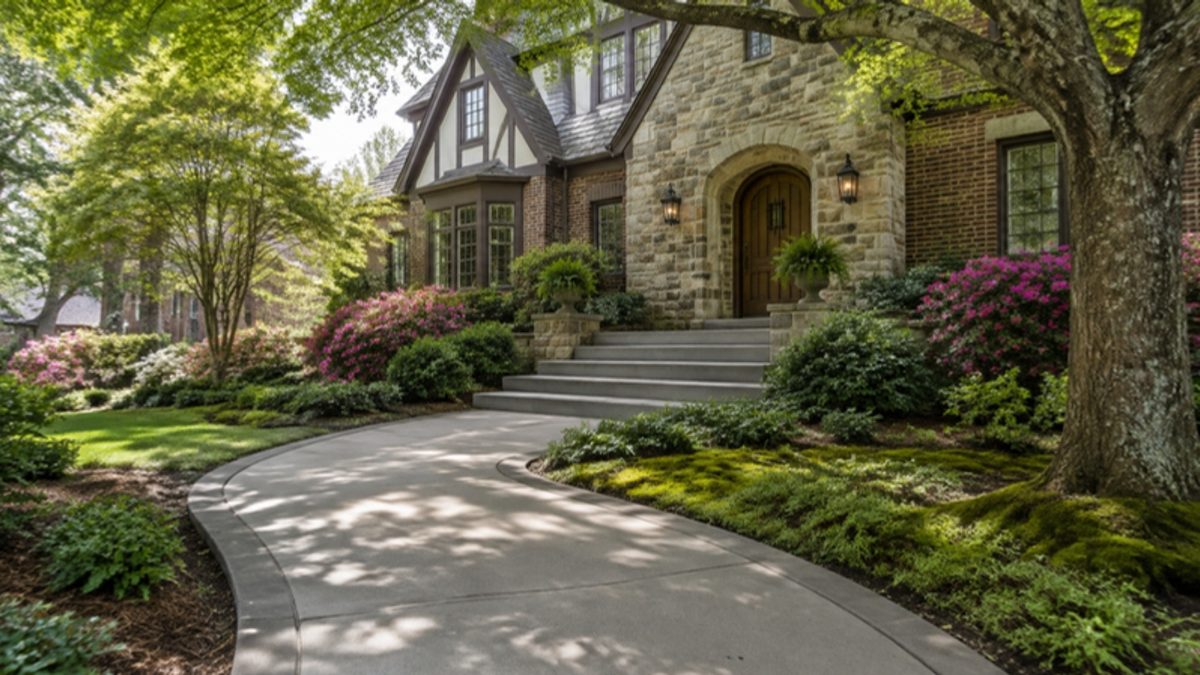
A planned suburb under a full canopy
Development began in 1929 under a real estate developer who hired a landscape architect to lay out estate-sized lots along winding, scenic roads, and the city incorporated in 1942. English Village, Mountain Brook Village and Crestline Village grew up as small commercial centers. Most of the land was built on without stripping the trees, and the city today is almost entirely under tree cover.
For concrete, that history means three things. Many houses are old enough that their walks and steps have been rebuilt at least once. Roots run under nearly everything. And appearance matters to most owners as much as function, so a new walk has to look like it belongs beside a house that may be close to a century old.
Working around big trees
Large oaks and other hardwoods spread roots well beyond the edge of their branches, and those roots are often right where a walk or driveway needs to go. Cutting a major root to make room for a base can injure or eventually kill the tree. Leaving it in place under a thin slab makes it very likely the slab will be lifted and cracked again.
Options include rerouting the walk with a gentle curve, bridging over a root zone with a thicker or reinforced section, or switching a short stretch to a different surface. A thoughtful contractor will ask about the trees you care most about before digging. If a tree is especially valuable, consider having an arborist look at the root zone before the plan is final.
Entry walks and steps that suit an older house
Front walks here are often the first thing guests see, and many lead to stone, brick or stucco houses with distinctive entries. Plain gray concrete can look stark against those materials. Common ways to soften it include an exposed aggregate finish, a light tint, a smooth troweled border around a broom-finished field, or brick or stone edging tied into what is already on the house.
Entry steps deserve particular attention. Older steps sometimes have risers of different heights or treads that slope toward the house. Rebuilding is a chance to make them consistent, add a landing where the walk meets the stoop, and plan for rails if needed. Ask to see examples of finishes and edge details before the pour, since they cannot be changed afterward.
Long, curving driveways
Lots set back from winding roads often have long driveways that curve through the trees, sometimes with a parking court near the house. Replacing one is a larger project than it first appears. The curve has to be laid out smoothly, joints have to follow the shape rather than cut across it at odd angles, and the whole thing has to drain without sending water toward the house or across a neighbor’s yard.
Many owners phase a long drive, replacing the worst stretch first. That can work, though the new section will look brighter than the old concrete for a while. If you plan to phase, ask the contractor where a clean break should fall and how the joint between old and new will be finished.
Shades Creek and low ground
Shades Creek runs through the city, and properties near it or near its tributaries can see water move quickly through low spots during heavy storms. Concrete in these areas needs a clear path for water off and around it. If your yard floods or stays soggy after rain, that is worth raising early, because a new patio or walk set slightly too low can trap water instead of shedding it.
Keeping the property intact during the work
- Agree on the route for trucks, pumps and wheelbarrows before work starts.
- Protect lawns, beds and irrigation lines along that route.
- Mark trees and root zones that must not be disturbed.
- Decide where old concrete will be stockpiled before it is hauled away.
- Confirm how stone or brick edging will be removed and reset, if it stays.
- Keep fresh concrete clear of falling leaves, pets and foot traffic.
Approvals in Mountain Brook
Mountain Brook has its own city offices, and some projects visible from the street may receive extra scrutiny. Rules can touch driveway width at the street, drainage and work near the right-of-way. Rather than assume, contact the city before scheduling and ask what, if anything, your project requires. If your neighborhood has an association, check with it too.
What homeowners here ask most
Can my front walk be replaced without hurting the oak beside it?
Often, yes, with planning. Shifting the route slightly, keeping the base shallow over the root zone, or bridging roots with a reinforced section can all reduce damage. Cutting large roots close to the trunk is what tends to harm a tree. Tell the contractor which trees matter most, and for a large, valuable tree consider an arborist’s opinion before the plan is final.
How can new concrete be made to match an older stone or brick house?
Plain concrete rarely matches exactly, but it can be made to complement older materials. Exposed aggregate, a light integral tint, a smooth border or brick and stone edging are common choices. Seeing samples or nearby finished examples helps. Remember that fresh concrete is lighter at first and mellows with time, so judge a finish by how it will look after a season or two.
Is it better to replace a long driveway all at once or in phases?
Doing it all at once gives a uniform look and a single disruption. Phasing spreads the work out and lets you replace the worst sections first. Phasing works best when the break between old and new falls at a natural point, like a curve or a change in grade. Ask the contractor where the joint should go and how it will be finished.
Why do the steps at my front door slope toward the house?
Older steps sometimes settle as the soil beneath them compresses or erodes, especially if downspouts empty nearby. Steps that tilt toward the house can direct water against the foundation and become slippery. If the tilt is slight and the steps are otherwise sound, adjusting drainage may help. If they are cracked or the risers are uneven, rebuilding is usually the better fix.
Does Mountain Brook require approval for new driveways or walks?
Some projects do, especially those that change how a driveway meets the street, affect drainage or alter what is visible from the road. Requirements can vary by location and scope. Call the city before work is scheduled and check with any neighborhood association. Sharing what you learn with the contractor helps keep the project on track.
How long should I keep traffic off a new front walk?
Light foot traffic is often fine after a short wait, but the concrete keeps gaining strength for weeks. Furniture deliveries, heavy planters and equipment should wait longer. In cool weather the timeline stretches. Ask the contractor for specific dates, and keep leaves, pets and lawn equipment off the surface until it has had time to harden properly.
Talk through your project
Start with the address, what you want poured or replaced, rough dimensions, and a few photos of the area and any existing concrete.
The work, by type
Concrete Driveways
New drives, widening and tear-out on sloped Birmingham lots.
Concrete Patios
Backyard patios pitched to carry storm water off, not in.
Stamped & Decorative Concrete
Pattern, color and aggregate finishes, and the sealer they need.
Walkways & Steps
Front walks, stoops and even steps up hillside yards.
Garage, Shed & RV Slabs
Pads for sheds, shops, garages, boats and campers.
Concrete Repair & Replacement
Reading a failed slab before choosing patch, lift or tear-out.
More of Jefferson County
Jefferson County overview
Birmingham, Homewood, Hoover, Trussville and the older terraced lots in between.
Hoover
Bluff Park slopes, Riverchase-era drives and newer Ross Bridge and Trace Crossings lots.
Vestavia Hills
Steep Shades Mountain lots, terraced patios and mid-century drives.
Homewood
Narrow drives, porch steps and alley access on older, closely spaced lots.
Trussville
Newer subdivision drives and patios along the upper Cahaba.