Residential concrete in Pelham
Pelham sits in northern Shelby County with Oak Mountain rising on its eastern side and creeks running through its lower ground. Its housing ranges from established neighborhoods on mature, tree-lined streets to planned communities built around a golf course. Back yards are where most Pelham concrete projects happen, so this page leans toward patios, stamped and decorative surfaces and the drainage behind them, along with driveway replacement on older lots.
A city shaped by its neighbors and its mountain
Pelham incorporated in 1964, partly in response to an annexation effort by a neighboring town, and grew steadily as homes and businesses spread south from Birmingham. Oak Mountain State Park lies at the city's eastern edge with miles of wooded ridges and lakes, and neighborhoods near it often have sloping, wooded lots. Buck Creek and the Cahaba River add low ground where water collects after storms.
Neighborhoods such as Chandalar have had decades to settle in, with mature trees and houses that are now on their second or third round of outdoor improvements. Ballantrae, a planned community around a golf course, and other newer subdivisions bring younger concrete and HOA review into the picture.
Replacing an aging patio
In the older parts of the city, many patios are original slabs that have cracked, tipped or sunk over the years. Common causes include soil settling beside the foundation, downspouts emptying at the edge, and tree roots working under the slab. Before deciding to replace, check whether the patio still slopes away from the house. A patio that now tilts toward the foundation is sending rain where it does the most harm.
Replacement is also a chance to rethink size and shape. Many owners want more room for furniture, a grill or a fire pit, or a patio that connects to a side gate or a walkway. Planning those connections at the start avoids awkward joints and extra pours later.
Stamped and decorative finishes
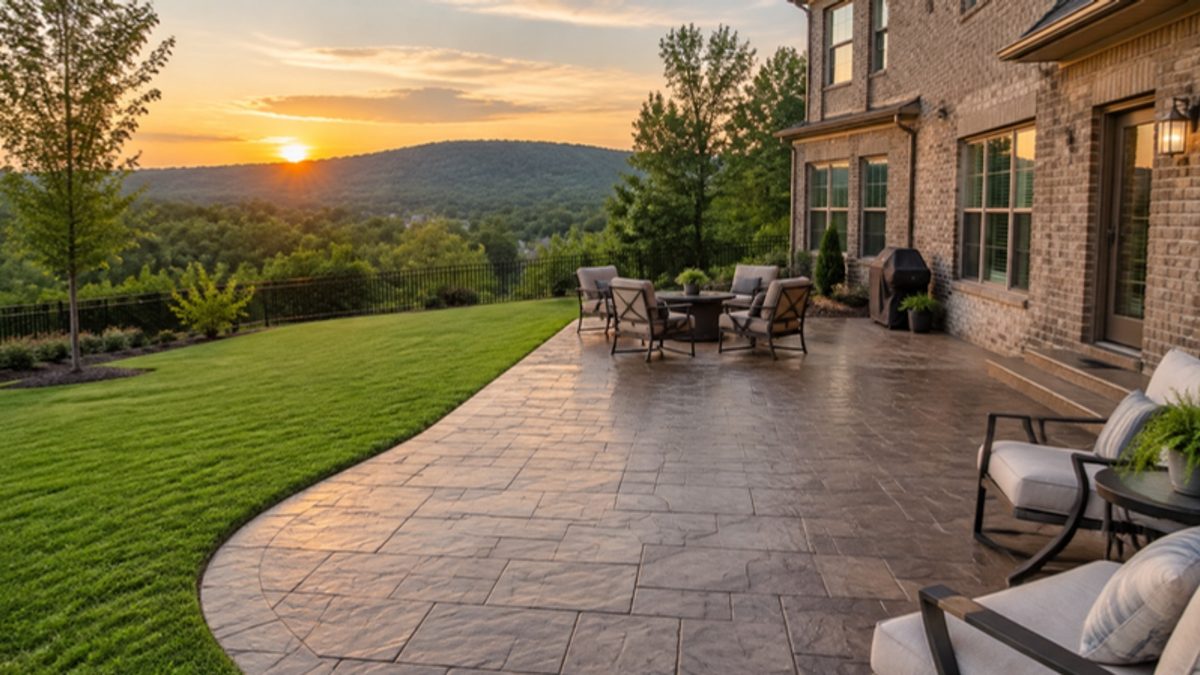
Stamped concrete is a popular choice for Pelham patios, often in slate, stone or brick patterns with color added. It gives the look of pavers in a single surface, but it has upkeep. Sealer needs periodic renewal, colors can fade in strong sun, and the smoother surface can be slick when wet unless a grit is added to the sealer.
When comparing decorative quotes, ask how color is added, whether integral color, surface color or both, and how the release agent will be handled. Ask also about the joint plan, because cuts that ignore the pattern can make a finished patio look patched. A good decorative estimate describes the sealer and how often it should be reapplied.
Back yards that slope toward the house
Lots near Oak Mountain and in hillier subdivisions often have back yards that rise away from the house. Water running down that slope collects against the back wall, and a patio placed there can trap it. A good plan pitches the patio away from the foundation and gives uphill water a way around it, often through a shallow swale, a curb along the high side or a drain at the low corner.
If the yard drops away instead, the patio may need extra base, a step down or a low retaining edge to stay supported. Both situations are common in Pelham, sometimes on the same street.
Creek-side lots near Buck Creek and the Cahaba
Properties along Buck Creek or near the Cahaba River can have softer soils and occasional flooding. Concrete in these areas needs a firm base and should not block the path that floodwater or runoff takes across the lot. Check whether your property is in a mapped flood area before planning new paving, and ask the city whether added hard surface needs review.
Questions for a Pelham patio estimate
- Which way will the patio pitch, and where does that water go?
- How will runoff from the uphill side be handled?
- What base will be placed, and how deep?
- For stamped work, how is color added and what sealer is used?
- Where will joints fall within the pattern?
- How will the patio connect to doors, steps, walks or gates?
Approvals and HOAs
Pelham has its own city offices, and many neighborhoods have HOAs that review visible changes, including new patios, driveway extensions and decorative work. Contact the city and your HOA before scheduling to find out what, if anything, needs to be submitted. Having that settled early keeps the project from stalling partway through.
What homeowners here ask most
Why does my old patio slope toward the house now?
Patios settle when the soil beside the foundation compresses, when water from downspouts washes out the base, or when roots shift the slab. Once a patio tilts toward the house, it sends rain against the foundation. If it is still in one piece, lifting may be an option. If it is broken or crumbling, replacement with a correct slope is usually better.
Is stamped concrete a good choice for a Pelham back yard?
It can be, if you are comfortable with maintenance. Stamped concrete offers a decorative look in a single surface, but it needs periodic resealing, colors can fade in strong sun, and it may be slick when wet unless grit is added to the sealer. Ask the contractor about color methods, sealer type and the recommended maintenance schedule.
My back yard slopes toward the house. Will a patio make drainage worse?
It can if it is placed without a drainage plan. A patio against an uphill slope can hold water against the house. Pitching the slab away from the foundation and adding a swale, curb or drain to send uphill water around it usually solves the problem. Mention any past water issues so the contractor can design the patio and drainage together.
Can I extend my existing patio instead of replacing it?
If the existing patio is level, sound and drains correctly, extending it is often practical. The new section needs a good connection and a matching slope. If the old slab has settled or cracked badly, extending it may carry the problem into the new work. A contractor can check the existing patio before you choose.
Our house is near Buck Creek. Is that a problem for new concrete?
Not necessarily, but it calls for extra care. Creek-side lots can have softer soils and occasional flooding, so the base needs to be firm and the slab should not block water moving across the lot. Check whether your property is in a mapped flood area and ask the city whether new paving needs review before you finalize the plan.
How often does a stamped patio need resealing?
It depends on the sealer, sun exposure and foot traffic. Many stamped patios need attention every few years to keep the color rich and the surface protected. Color that looks washed out or blotchy, rain soaking in instead of beading, and worn paths where people walk most are the usual cues. Ask the contractor which product they use and how often they recommend renewing it.
Talk through your project
Start with the address, what you want poured or replaced, rough dimensions, and a few photos of the area and any existing concrete.
The work, by type
Concrete Driveways
New drives, widening and tear-out on sloped Birmingham lots.
Concrete Patios
Backyard patios pitched to carry storm water off, not in.
Stamped & Decorative Concrete
Pattern, color and aggregate finishes, and the sealer they need.
Walkways & Steps
Front walks, stoops and even steps up hillside yards.
Garage, Shed & RV Slabs
Pads for sheds, shops, garages, boats and campers.
Concrete Repair & Replacement
Reading a failed slab before choosing patch, lift or tear-out.