Residential concrete in Pell City
Pell City is a county seat, an old mill town and a lake community all at once. In town, older houses sit along established streets near the former mill. Out toward the water, homes on Logan Martin Lake sit on wooded lots that drop toward the shoreline. Concrete questions here split along those lines. This page covers driveways and boat pads on lake lots, upkeep of older in-town concrete, and the limestone ground found in parts of the area.
From mill town to lake city
Pell City was founded in 1890 and grew around a textile mill that kept running, under more than one owner, until 2006. The mill village was merged into the city in 1956, and the mill district is now a recognized historic district. Pell City shares county seat duties with Ashville. Logan Martin Lake, formed when its dam was completed in 1964, gives the city a long shoreline, and many of the area’s homes face the water.
Interstate 20 crosses the northern part of the city, with U.S. 231 and U.S. 78 running through as well. Newer subdivisions have grown up near those routes, while the most sought-after lake homes often sit just outside the city limits.
Lake-lot driveways that drop toward the water
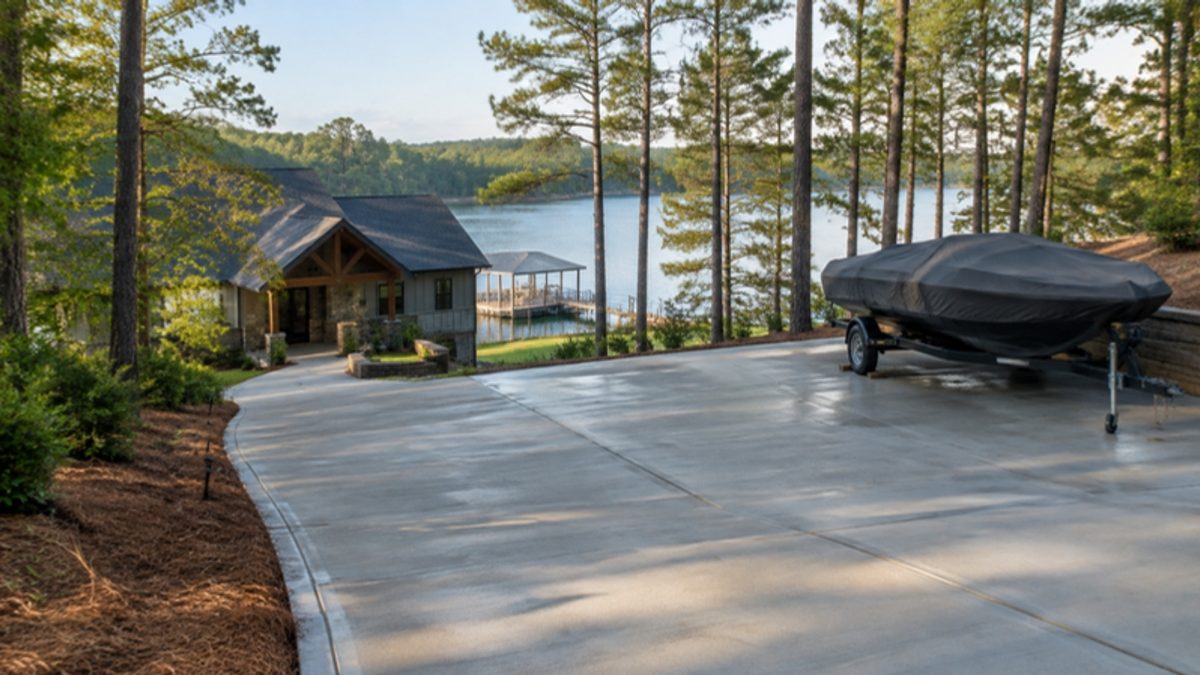
Waterfront lots frequently slope from the road down to the house and on to the shoreline. Driveways can be steep, curving and long, sometimes ending in a turnaround or a parking area on a cut shelf. Runoff from the road and the drive itself heads straight for the lake, carrying soil with it if the edges are not protected.
A good lake-lot plan accounts for traction on the slope, a firm base on cut and fill, and a controlled path for water at the bottom so it does not undercut the slab or wash into the lake. Ask the contractor how the drive will meet the road at the top and how the parking area will drain at the bottom.
Boat pads and trailer parking
Many lake owners want a place to park a boat on its trailer, along with room to back it in and out. A loaded trailer concentrates weight on small tires and a tongue jack, which can crack a thin slab. Boat pads are usually thicker than a standard driveway, with reinforcement and a well-compacted base.
Think about the turning path as well as the pad itself. Trailers need room to swing, and jackknifing tires off the edge will break it over time. Tell the contractor the size and weight of the boat and trailer so the pad and approach can be sized for them.
Limestone ground and sinkholes
Parts of St. Clair County sit over limestone, which can dissolve slowly and leave voids underground. A sinkhole on U.S. 231 north of I-20 has reopened several times, and state highway officials have pointed to the underlying limestone as the cause. Most cracked residential concrete has more ordinary explanations, but sinkholes are a real possibility in the area.
Signs worth checking before a pour include a round depression that appears suddenly, soil that disappears into a hole, or a low spot that keeps coming back after it is filled. If you notice any of these, have the ground assessed before new concrete goes over it.
Older concrete in town
In established parts of the city, front walks, steps and narrow driveways may be decades old. Typical problems include steps that have settled away from the porch, walks lifted by tree roots and driveways patched many times. Some of that concrete is still sound and only needs crack sealing and drainage fixes, while badly broken or uneven sections are better replaced.
Before scheduling lake or in-town work
- Check with the city or county, depending on whether the lot is inside the city limits.
- Ask about any shoreline rules that apply near the water.
- Plan where runoff from new paving will go.
- Size boat pads and turning space for the trailer you actually own.
- Look for signs of sinkholes or unexplained settling.
- Confirm how a concrete truck will reach a steep or narrow lot.
City, county and shoreline approvals
Some lake homes are inside the Pell City limits and some are in unincorporated St. Clair County, so the office that reviews your work depends on the address. Work close to the water may involve additional shoreline rules from whoever manages the lake edge. Check with the city or county, and ask about shoreline requirements, before planning concrete near the lake.
What homeowners here ask most
How do I keep a steep lake driveway from washing out at the bottom?
Water picks up speed on a steep drive and can undercut the slab or wash soil toward the lake. A good plan includes edge protection, a controlled outlet at the low end, and sometimes a trench drain or swale. Describe how water moves across the lot during heavy rain so the contractor can design the slab and drainage together.
How thick should a boat pad be?
Boat pads are usually thicker and more reinforced than standard driveways because trailer tires and tongue jacks concentrate weight on small areas. The base matters as much as the slab. The right thickness depends on the weight of the boat, trailer and soil conditions. Tell the contractor what you will park there so the pad is designed for it.
Are sinkholes a real concern around Pell City?
They can be. Parts of the area sit over limestone, and a well-known sinkhole along U.S. 231 has reopened more than once. Most residential cracks have ordinary causes, but a sudden round depression or a hole that keeps reopening deserves a closer look before new concrete is poured over it.
Do lake homes near Pell City need special approval for concrete?
Possibly. Approval depends on whether the lot is inside the city limits or in unincorporated St. Clair County, and work near the shoreline may have its own rules. Check with the appropriate office and ask about shoreline requirements before scheduling. Share what you learn with the contractor, since a boat pad or drive close to the water may need to be placed or sized around those rules.
Can a concrete truck reach a house below the road?
Sometimes, but steep, narrow drives and tight turnarounds can make it difficult or unsafe for a heavy truck. A pump that sends concrete through a hose from the road is a common solution. Describe the slope, turns and any soft ground when you request an estimate so the contractor can plan access.
Is my old in-town walkway worth saving?
A walk that still sits flat, sheds rain toward the yard and shows only fine cracks that are not growing can often be kept with crack sealing and a drainage fix. If panels are broken, lifted by roots or create trip edges, replacement is usually the safer choice. A contractor can look at the walk and tell you which sections are sound.
Talk through your project
Start with the address, what you want poured or replaced, rough dimensions, and a few photos of the area and any existing concrete.
The work, by type
Concrete Driveways
New drives, widening and tear-out on sloped Birmingham lots.
Concrete Patios
Backyard patios pitched to carry storm water off, not in.
Stamped & Decorative Concrete
Pattern, color and aggregate finishes, and the sealer they need.
Walkways & Steps
Front walks, stoops and even steps up hillside yards.
Garage, Shed & RV Slabs
Pads for sheds, shops, garages, boats and campers.
Concrete Repair & Replacement
Reading a failed slab before choosing patch, lift or tear-out.