Residential concrete in Trussville
Trussville has grown quickly since the interstates arrived, and most of its housing is newer than the Birmingham average. That means many homeowners are not replacing concrete so much as adding to it: a wider driveway, a parking pad for a trailer, a bigger patio or a walkway around the side of the house. This page focuses on extending and enlarging concrete on a newer lot, with some notes on the city’s older core and its stretch of the Cahaba River.
From a planned 1930s community to a fast-growing suburb
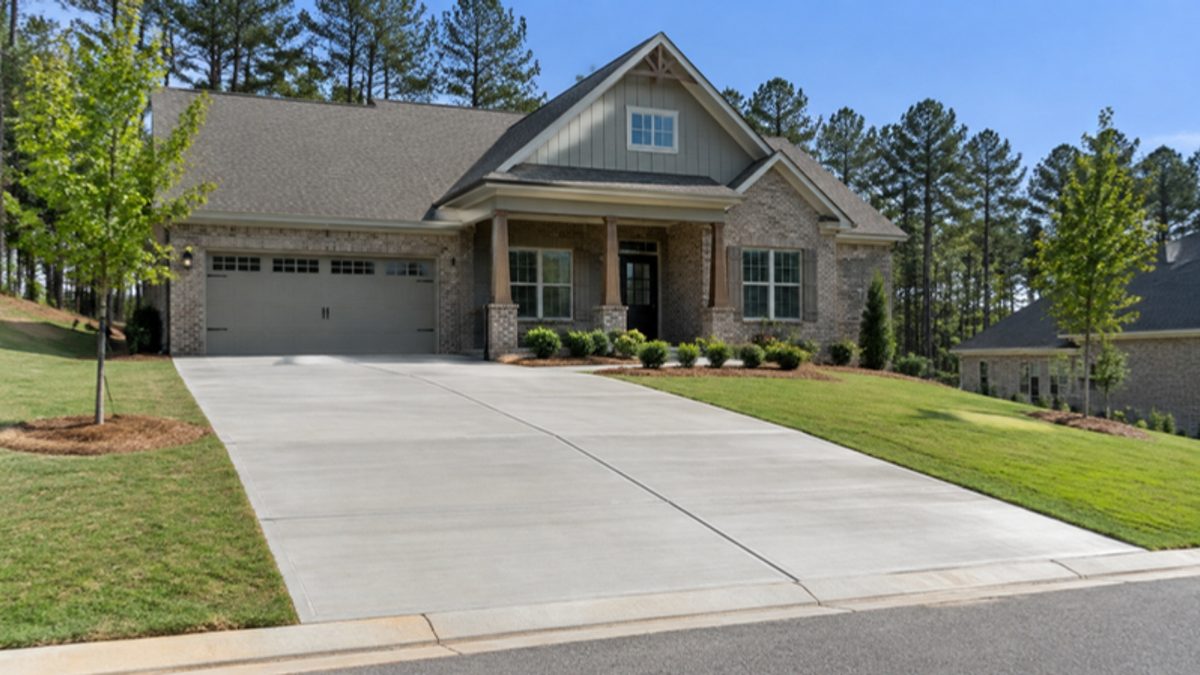
Trussville stayed small for a long time. A federally planned community known as the Cahaba Project was built here starting in 1938, with homes, parks, sidewalks and streetlights laid out together. The bigger change came later, when I-59 and I-459 made the city an easy commute. In the mid-1980s Trussville roughly tripled its land area, and subdivision building has continued since. Most of the city is in Jefferson County, with a portion in St. Clair County.
So there are two very different kinds of concrete here. In the older core, walks and drives may be decades old and hand-built. In the subdivisions, the concrete is younger, wider and usually poured by the original builder, often on ground that was graded and filled for the house pad.
Widening a driveway or adding a parking pad
A common request is to add width beside an existing driveway, often for a third car, a boat or a work trailer. The new section has to tie into the old one without creating a ledge or a crack line. Contractors typically drill and dowel into the edge of the existing slab or separate the two with an isolation joint, depending on the situation. Ask which approach they plan and why.
Think about thickness, too. A pad that will hold a loaded trailer or a heavy truck may need more depth and reinforcement than the original driveway. Also consider where water from the extra hard surface will go. Many subdivision lots were graded with little room to spare, and a new pad can easily push runoff toward a neighbor or the house.
Matching color and finish
New concrete beside old concrete almost never matches on the first day. Fresh concrete is lighter, and differences in cement, sand and finishing technique show up as variations in tone and texture. Over a season or two, the difference usually narrows as the new surface weathers.
If a close match matters, discuss it before the pour. A similar broom direction and texture helps, and some owners use a deliberate border or band to separate old from new so the difference looks intended. Cleaning the existing driveway before comparing colors gives a fairer picture.
Patios behind newer homes
Many builder patios in Trussville subdivisions are small slabs just outside the back door. Owners often want to extend them, add steps down to the yard, or pour a new, larger patio that wraps toward a fire pit or grill area. Because back yards in these neighborhoods often slope, the extension may need a step, a low wall or extra base to stay level.
Settling fill is a common issue behind newer houses, where soil was pushed in during construction. If the existing patio has dropped or cracked, extending it without understanding why can carry the same problem into the new work.
Near the Cahaba River
The Cahaba River runs through Trussville, and properties near it or its small tributaries may have soft ground, a high seasonal water table or flood exposure. Before adding concrete on low ground, check whether your property lies in a mapped flood area and ask the city whether any review applies. Water that moves through a low yard needs a path that new paving does not block.
Planning an addition to existing concrete
- Decide how the new section will connect to the old slab.
- Confirm the thickness needed for the heaviest vehicle that will use it.
- Check property lines and setbacks before marking the new edge.
- Look at where runoff will go once the paved area grows.
- Ask how joints in the new section will line up with the old ones.
- Talk through color and texture expectations before the pour.
HOAs and city review
Many Trussville subdivisions have HOAs that review driveway widening, parking pads and other visible additions, and some restrict where boats and trailers may be parked. The city may also have requirements for work near the street or changes in drainage. Check with both before scheduling, so the plan can be adjusted early instead of after concrete is down.
What homeowners here ask most
Can a third parking space be added beside my driveway?
Often, if the lot has room and the HOA and city allow it. The new section needs a firm base, enough thickness for the vehicle it will carry, and a sound connection to the existing slab. It also adds runoff that needs somewhere to go. Check setbacks and any HOA rules first, then have a contractor measure and plan the layout.
Will a new driveway extension match my existing concrete?
Probably not exactly at first. Fresh concrete looks lighter and can differ in texture. The gap often narrows as the new surface weathers over a season or two. Matching the broom direction and finish helps, and some owners add a border to make the transition look deliberate. Discuss your expectations before the pour.
My builder patio is small. Should I extend it or start over?
If the existing patio is level, sound and drains away from the house, extending it can work well. If it has settled, cracked badly or slopes toward the house, replacing it with a single larger slab may give a better result. A contractor can check the existing patio and the ground behind it before you decide.
How thick should a pad for a boat or camper be?
Pads for heavy trailers and campers are generally thicker and more heavily reinforced than a standard walk or patio, and the base underneath matters just as much. The right thickness depends on the load and the soil. Tell the contractor what will park there, including its weight if you know it, so the slab is designed for that use.
Does my HOA need to approve a driveway extension?
Many do. HOAs commonly review changes visible from the street, including wider driveways and parking pads, and some limit where boats or trailers can be stored. Check your covenants and submit any required plans before scheduling. It is also worth asking the city whether work near the street needs review.
Our yard near the river stays wet. Can we pour a patio there?
It may be possible, but wet ground calls for extra planning. A thicker base, better drainage around the slab or a different location might be needed. Low areas near the river can also fall within mapped flood zones that bring additional review. Check the flood map, ask the city, and share what you find with the contractor before designing the patio.
Talk through your project
Start with the address, what you want poured or replaced, rough dimensions, and a few photos of the area and any existing concrete.
The work, by type
Concrete Driveways
New drives, widening and tear-out on sloped Birmingham lots.
Concrete Patios
Backyard patios pitched to carry storm water off, not in.
Stamped & Decorative Concrete
Pattern, color and aggregate finishes, and the sealer they need.
Walkways & Steps
Front walks, stoops and even steps up hillside yards.
Garage, Shed & RV Slabs
Pads for sheds, shops, garages, boats and campers.
Concrete Repair & Replacement
Reading a failed slab before choosing patch, lift or tear-out.
More of Jefferson County
Jefferson County overview
Birmingham, Homewood, Hoover, Trussville and the older terraced lots in between.
Hoover
Bluff Park slopes, Riverchase-era drives and newer Ross Bridge and Trace Crossings lots.
Vestavia Hills
Steep Shades Mountain lots, terraced patios and mid-century drives.
Mountain Brook
Front walks and steps on wooded, winding lots near the three villages.
Homewood
Narrow drives, porch steps and alley access on older, closely spaced lots.